Veneers are one of the most common cosmetic dentistry treatments, and they are also one of the most often misapplied when the underlying problem is something else. A veneer is a bonded shell that changes the color, shape, and surface contour of the front teeth. It does not treat decay, periodontal disease, or a failing bite, and it cannot strengthen a fractured tooth. This guide explains how dental veneers work, which materials suit which cases, and how to tell whether they are the right answer for patients in Newburgh, NY.
Table of Contents
- Quick Takeaways
- What Veneers Are and What They Correct
- Veneer Types and Their Trade-offs
- Who Is a Good Candidate for Veneers?
- What the Veneer Process Involves
- Cost and Payment Planning
- Maintenance, Longevity, and Failure Patterns
- Planning a Smile Makeover in Newburgh
- Frequently Asked Questions
- References
Quick Takeaways
| Key Insight | Explanation |
|---|---|
| Veneers correct appearance only | A veneer addresses color, shape, and surface defects on the facial surface. It does not reinforce a compromised tooth the way a crown does. |
| Active decay and gum disease come first | Veneers are only an option when extensive cavities and gum disease are absent. Stabilize those conditions before any shell is fabricated. |
| Material determines the preparation | Conventional porcelain requires enamel reduction and laboratory fabrication. Direct composite can be placed in one visit but stains and wears sooner. |
| Persistent staining points toward veneers | Discoloration that does not respond to tooth whitening is a common indication. Whiten the natural teeth first so the final shade is chosen against a stable baseline. |
| Assess the bite before committing | Bruxism, deep overbites, and edge-to-edge anterior contacts load the incisal edge. Evaluate occlusion in centric and lateral movements before accepting a plan. |
| Request a written plan with a fee after examination | Veneer fees depend on tooth count, material, and complexity. The in-office dental plan provides 15% off all services, with terms and conditions that apply. |
What Veneers Are and What They Correct
A dental veneer is a thin, custom-made shell bonded to the front surface of a tooth. Its job is to change the optical and contour characteristics of the visible tooth, including color, translucency, shape, and apparent length. Cleveland Clinic describes veneers as shells that conceal cracks, chips, stains, and other cosmetic imperfections, and that is an accurate description of the treatment’s scope.
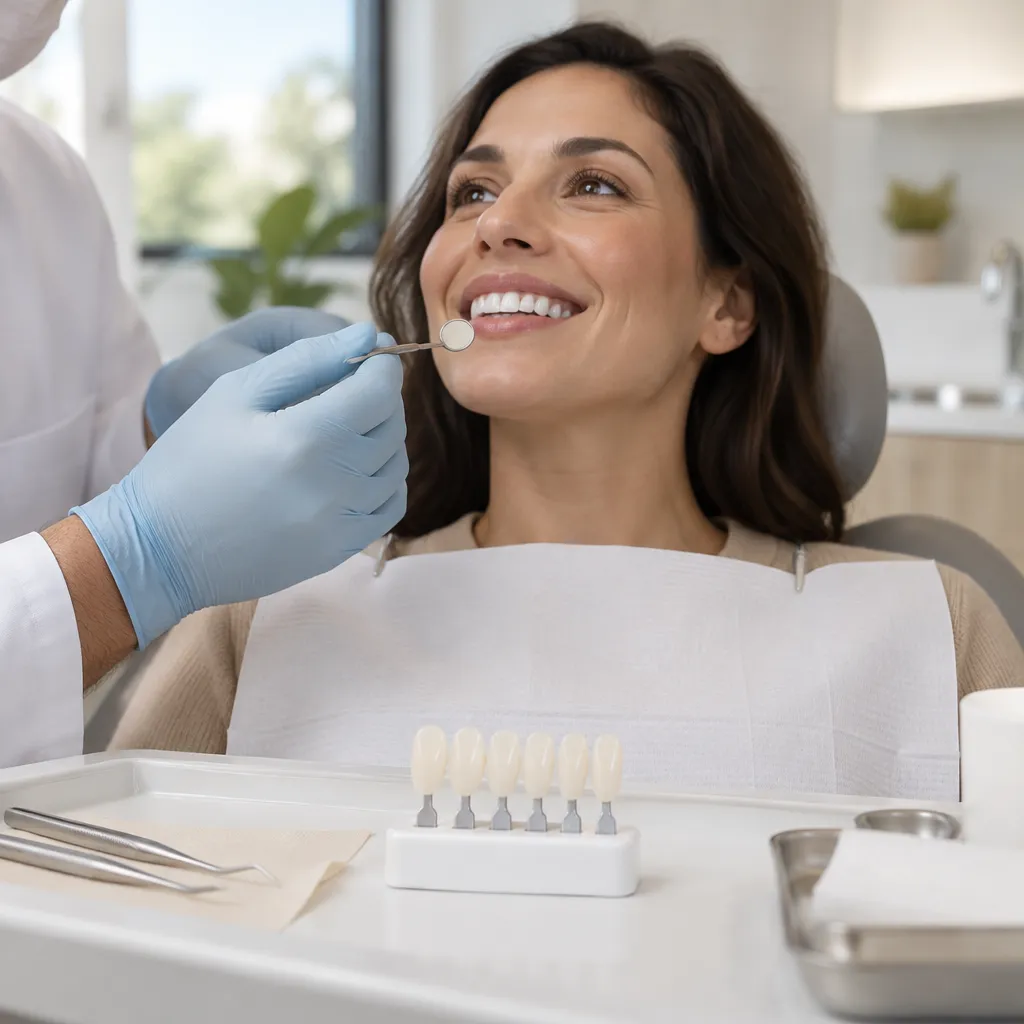
Common indications include chipped or broken teeth, diastemas, stains that do not respond to whitening, teeth that are too small, and misshapen teeth. The most predictable results come from isolated cosmetic problems, such as one discolored incisor with healthy surrounding tissue, or worn edges on otherwise sound teeth. When the problem is structural, a different restoration usually makes more sense.
Porcelain and composite materials
Veneers are fabricated from either porcelain or composite resin. Porcelain is typically made in a dental laboratory from a model of the prepared tooth, which allows the ceramist to layer translucency and shade. It resists staining better than composite and holds its surface finish well, but it is brittle in thin sections and depends on a correct bonding protocol to avoid debonding or fracture.
Composite is sculpted directly onto the tooth in a single visit and does not require laboratory fabrication. Its trade-off is a greater tendency toward surface staining and wear, and its polish degrades more readily over time. Repairs are simpler with composite because material can be added chairside without replacing the entire restoration.
Veneers versus crowns
This distinction drives treatment planning. A porcelain veneer covers only the facial surface of a tooth to improve appearance, while a crown encloses the entire clinical crown to add strength and protection. Veneers do not meaningfully reinforce a compromised tooth.
A crown is indicated when a tooth has been badly damaged by decay or trauma, or when it has undergone root canal therapy and lost substantial structure. Placing a veneer on a tooth that needs full coverage is a planning error, and it typically fails early at the margin or the incisal edge.
Veneer Types and Their Trade-offs
Cleveland Clinic recognizes composite, porcelain, no-prep, and removable veneers. Removable veneers are a dental appliance rather than a bonded restoration, so they fall into a different category of treatment. The three bonded options differ mainly in how much tooth structure is removed, how the material ages, and how easily the result can be revised.
Conventional porcelain with enamel reduction
Conventional porcelain veneers require removing a thin layer of facial enamel so the shell sits flush with adjacent teeth rather than creating unnatural bulk. The reduction is irreversible, which is why the decision should be made deliberately. A well-fitted porcelain veneer on healthy enamel is the most durable option for a lasting cosmetic change, and it tolerates polishing and gingival contact better than composite.
No-prep and direct composite options
No-prep veneers are designed to minimize or avoid enamel removal, which appeals to patients who want to preserve natural tooth structure. In practice, a no-prep shell often requires slight buildup, and it works best when the change needed is modest. Direct composite veneers avoid the laboratory step, but they accumulate staining from coffee, tea, and tobacco and need periodic polishing or replacement. Choose composite when a same-day result matters more than long-term surface stability.
| Veneer Type | Primary Trade-off | Best Fit |
|---|---|---|
| Conventional porcelain | Irreversible enamel reduction and laboratory fabrication, with strong stain resistance | Multi-tooth changes on sound enamel with a stable bite |
| Direct composite | Completed in one visit, but more prone to surface staining and wear, and repairable chairside | Single teeth, budget-sensitive cases, or patients testing a change in shape or shade |
| No-prep | Minimal or no enamel removal, but limited to modest changes and often requires slight buildup | Mild shape or spacing corrections where preserving enamel is the priority |
Who Is a Good Candidate for Veneers?
Cleveland Clinic states that veneers are only an option when a patient is free of extensive cavities and gum disease, and that serious oral health issues should be addressed first. We apply that sequence strictly. A veneer bonded over an active carious lesion traps bacteria at the margin, and a shell placed over inflamed gingiva makes the periodontal condition harder to assess and manage.
Active decay and periodontal status
Before a veneer is planned, the clinician should confirm that caries is controlled, that existing restorations are sound, and that probing depths and bleeding findings are stable. Gum disease treatment, including scaling and root planing where indicated, should precede impressions. A large composite on the proposed veneer site is often replaced at the same appointment so the margin lands on sound enamel and the restorations match in translucency.
Bite, enamel volume, and tooth size
Occlusion determines whether a veneer survives. Patients with heavy nocturnal bruxism, deep vertical overbites, or edge-to-edge anterior contacts place high shear loads on the incisal edge, and chipping is the usual result. Enamel volume is the second factor. Teeth with thin, hypoplastic, or eroded enamel offer a weaker bonding substrate, and a crown may be more reliable in those cases. Teeth that are too small can sometimes be built up with bonding instead, which is less invasive but has its own limits in longevity.
Veneers change how a tooth looks. They do not change why the tooth broke, stained, or shifted, so the diagnosis should come before the shell.
Pro tip: Ask for an assessment of your bite in centric occlusion and in lateral excursions before accepting a veneer plan. A tooth that looks acceptable at rest can fail quickly under a grinding pattern you do not notice while awake.
What the Veneer Process Involves
A veneer case moves through diagnosis, preparation, fabrication, and bonding. Each stage contains a decision point, and most failures trace back to a shortcut in the first one. Conventional porcelain generally requires at least two appointments, one for preparation and temporaries and one for seating, while direct composite can be completed in a single visit.
Records, shade selection, and mock-up
Diagnostic records include retracted and smiling photographs, radiographs, and a shade assessment taken before the teeth dehydrate. Shade is selected in natural light against a neutral background, and the target shade is recorded for the laboratory. A mock-up, a provisional made in composite over the existing teeth, lets the patient evaluate proportion and length before any enamel is removed. We consider the mock-up the most important step, because it converts a general cosmetic goal into a specific design.
Enamel reduction and temporary restorations
For porcelain, the clinician removes a controlled thickness of facial enamel while preserving contact points and keeping the incisal edge in harmony with the opposing teeth. Margins are placed in enamel where possible, because bonding to enamel is more predictable than bonding to dentin. Temporary veneers are worn while the laboratory fabricates the final restorations, and patients should avoid biting into hard food with them, since temporaries are less durable and can dislodge.
Bonding and post-placement adjustment
At seating, the tooth surface is etched, primed, and bonded with resin cement. Excess cement is removed before final light curing, because residual ledges at the margin accumulate plaque. The bite is checked in every excursion, since a veneer that contacts early will load the incisal edge and fail. A follow-up bite check after a week of normal function is a reasonable step to confirm the occlusal scheme has settled.
Cost and Payment Planning
Veneer fees depend on the number of teeth, the material chosen, laboratory work, and the complexity of the preparation. The final figure is set after a clinical examination, because a number quoted without an exam does not reflect the actual case. Patients should ask for a written treatment plan that lists each tooth, the material, and the included appointments.
Using the in-office dental plan
Patients without dental insurance can enroll in our in-office dental plan, which includes 2 Diagnostic Exams, 2 Routine X-Rays, 2 Dental Cleanings, and 15% Off All Services. Plan terms and conditions apply, so call (845) 562-1108 for details before assuming the discount applies to a specific fee. The diagnostic exam and radiographs included in the plan are the same records needed for veneer planning, so scheduling the assessment early is efficient.
Insurance classification and documentation
Dental plans frequently classify veneers as cosmetic and exclude them, even when the clinical driver is a fractured or structurally compromised tooth. When a veneer treats trauma or a defect with functional consequences, the diagnosis, photographs, and radiographs need to be documented clearly. Ask the insurer for the exact exclusion language before scheduling, because coverage is determined by the policy wording rather than by the clinical intent of the treatment.
Maintenance, Longevity, and Failure Patterns
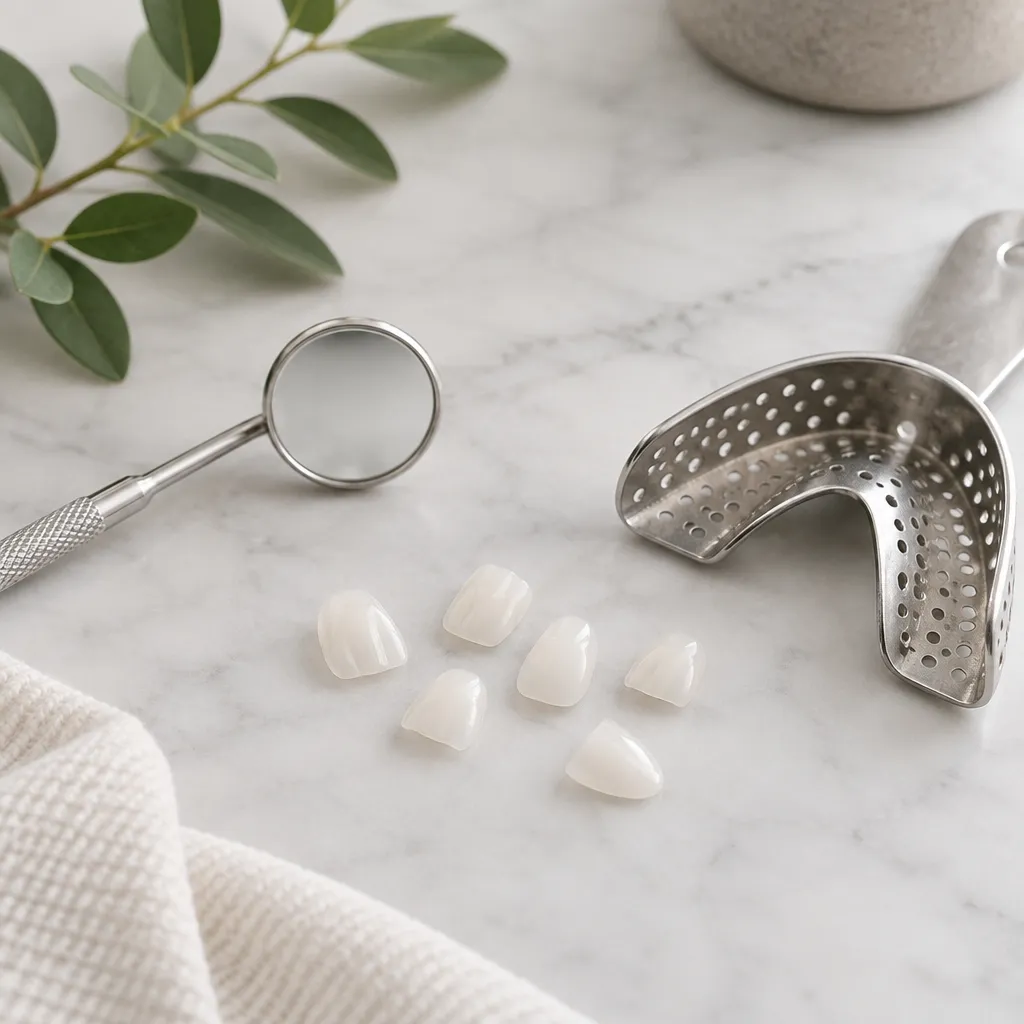
A well-placed porcelain veneer can serve for many years, but its service life depends on the bite, the hygiene routine, and the quality of the bonded margin. In general practice, the most frequent failures are incisal chipping, marginal staining, and debonding after trauma or contact with hard food. Each has a different cause and requires a different response.
Bruxism and occlusal protection
Patients who grind or clench should wear a nightguard fabricated to their bite, and the guard should be checked at recall for wear. Veneers themselves wear slowly, but the opposing dentition and the veneer margins take the load. A chipped veneer edge in a patient who grinds is usually a sign that the occlusal scheme needs review, not just a cosmetic repair.
Margins, staining, and hygiene
Marginal staining usually indicates a microgap at the cement line or a surface that has been polished poorly. Use a soft-bristled brush and a low-abrasive paste, and ask the dentist before using whitening trays over veneers, since whitening agents do not change the shade of porcelain or the bonded interface. Composite veneers respond to professional polishing and, in some cases, to localized repair with additional composite. Regular professional cleanings help identify early marginal changes before they become visible.
Pro tip: Keep a dated set of photographs of your veneers at placement. Comparing future images against that baseline is the simplest way to detect early marginal staining or a subtle shift in the incisal edge.
Planning a Smile Makeover in Newburgh
A smile makeover combines several cosmetic and restorative procedures in a defined sequence. In most cases, the sequence starts with professional whitening to establish a stable shade baseline, followed by treatment of any active decay or gum disease, and then veneers or bonding for shape and structural corrections. Veneers placed before whitening will not change color, so the shade decision must be finalized first.
Sequencing whitening, bonding, and veneers
Whitening is usually the first step when a patient wants a lighter shade, because it sets the target before the veneer shade is selected. Bonding can correct small chips or limited diastemas where the defect is confined to one or two surfaces. Full veneers are reserved for cases where several teeth need shape or color correction together. Crowns enter the plan when a tooth requires full coverage, such as after root canal therapy or after extensive loss of structure. You can review our teeth whitening options in Newburgh before deciding on the sequence, and our dental crowns page covers the cases where a crown is the better choice.
Scheduling at our Newburgh office
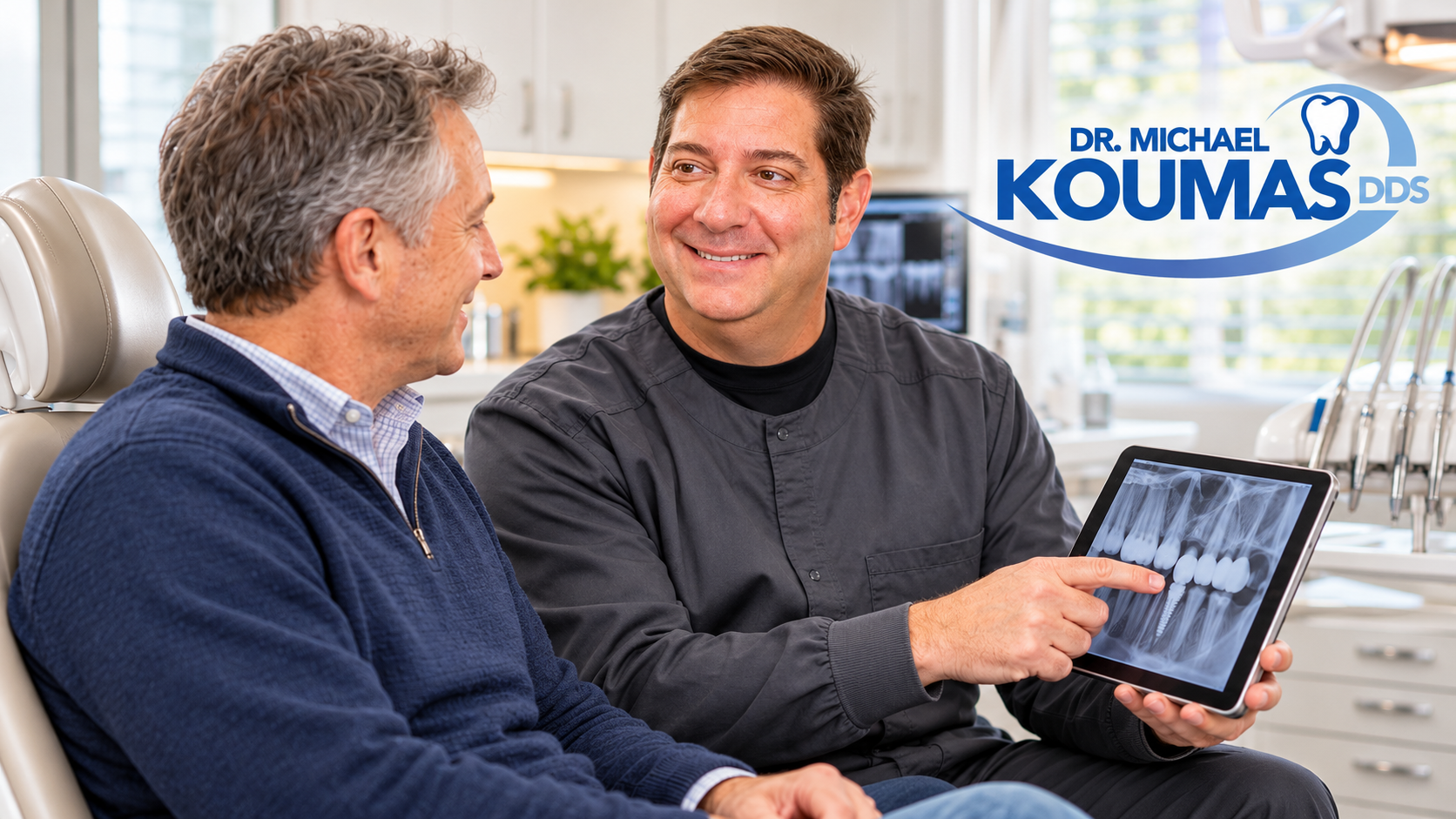
Dr. Michael Koumas has over 25 years of experience and leads cosmetic planning at our practice at 4 Hudson Valley Professional Plaza #1, Newburgh, NY 12550. The office is open Monday to Friday, 9:00 AM to 5:30 PM. Patients from Beacon, Balmville, New Windsor, Cornwall, Walden, Marlboro, Gardiner, and Wallkill are within our service area. For a chipped veneer or a dislodged restoration, call (845) 562-1108 as soon as possible, and for serious medical emergencies call 911. Our general dentistry services are described on our general dentist in Newburgh page, and the Newburgh location page lists the practice details.
Frequently Asked Questions
Can a veneer be placed on a tooth that has had a root canal?
A veneer can improve the appearance of an endodontically treated tooth if the remaining structure is sound and the tooth is stable. Root-treated teeth often have reduced structure and may discolor from the treatment, so a crown is frequently the more reliable choice when a substantial portion of the crown is missing.
Do porcelain veneers stain?
Porcelain resists surface staining far better than composite. The bonded interface at the margin can still discolor over time if the seal is compromised, which is why marginal integrity matters at each recall visit.
Are veneers painful to place?
Enamel reduction for conventional porcelain is commonly performed under local anesthesia, and most patients tolerate the process well. Sensitivity afterward is usually temporary and is managed by keeping the temporaries intact and avoiding hard food until the final restorations are bonded.
Will teeth whitening change my veneers?
No. Whitening agents do not alter porcelain or the bonded resin cement, and composite surfaces respond only minimally. Whiten your natural teeth first, then select the veneer shade against the stabilized result.
Are veneers covered by dental insurance?
Coverage varies. Many plans classify veneers as cosmetic and exclude them, while treatment for trauma or functional damage may be handled differently. Review the policy’s exclusion language and call (845) 562-1108 to discuss the in-office dental plan and the documentation your insurer may require.
Have you had veneers, or are you weighing them against whitening or bonding, and which questions would help you decide?