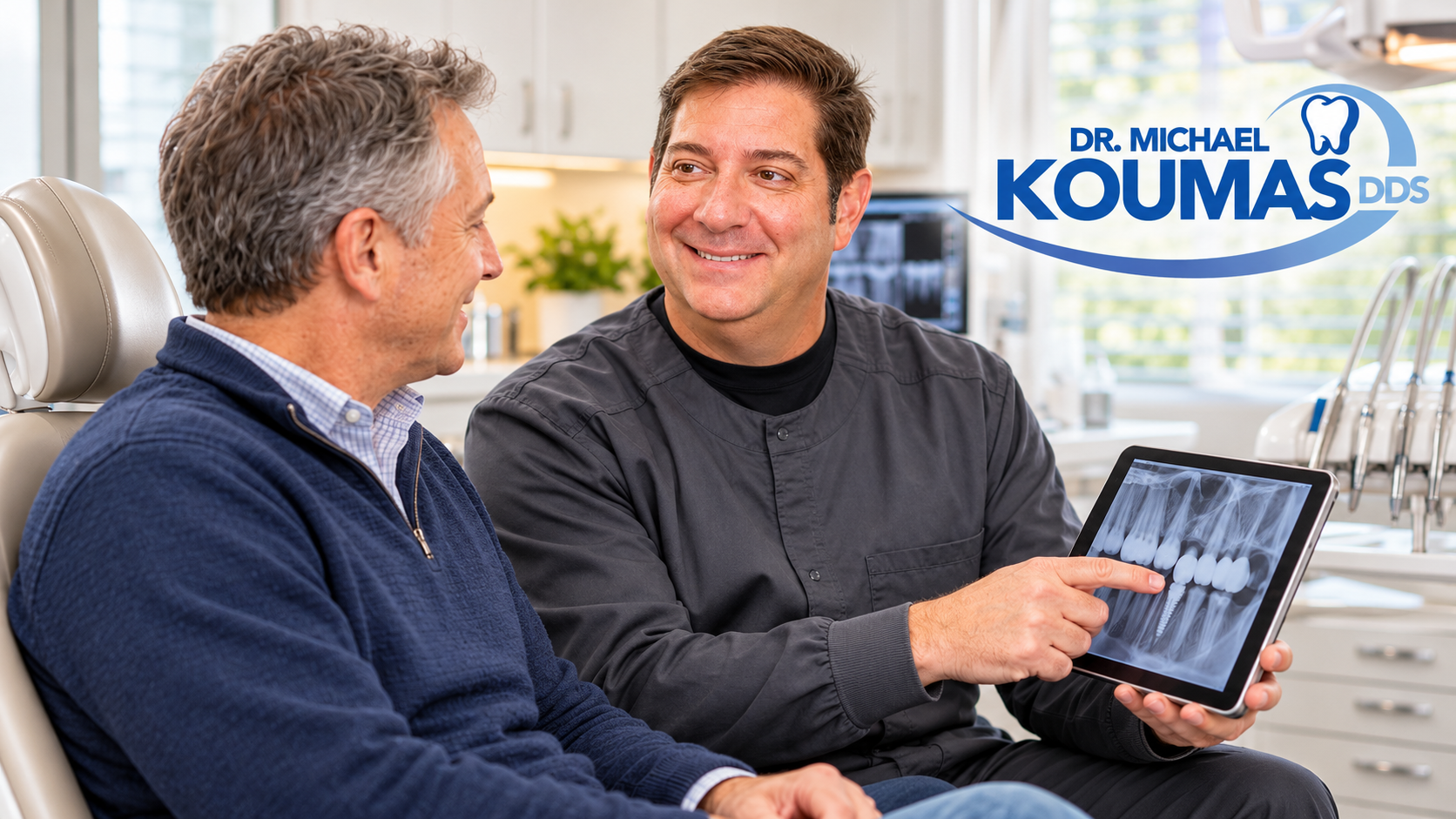
Holiday meals put specific demands on your teeth. Turkey, crusty rolls, nuts, and sticky desserts require reliable bite force, and a crowded table requires clear speech and a smile you do not have to think about. For patients with missing teeth, those demands expose the weak points of their current solution, whether that is a partial that shifts under pressure or a closed-mouth smile used to hide a gap. Dental implants are one of the most stable answers to that problem, but they require planning. This article compares implants with dentures, explains how treatment is sequenced, and shows how to time your care so your next gathering is one you enjoy.
Table of Contents
- Quick Takeaways
- Why Missing Teeth Change Holiday Meals and Conversation
- How Dental Implants Are Placed and Timed
- Implants Versus Dentures at the Holiday Table
- Implants, Dentures, and Bridges Compared
- Planning Treatment Around the Holiday Calendar
- Maintaining Implants Through Holiday Eating
- Who Qualifies for Implants in Newburgh
- Frequently Asked Questions
- References
Quick Takeaways
| Key Insight | Explanation |
|---|---|
| Start early | Implant treatment runs for months. A couple of months typically passes between placement and the abutment, and the crown follows, so a late-November start will not produce a finished crown by the winter holidays. |
| Bone decides candidacy | Implants need enough bone to hold the post. Dentures can be fabricated regardless of bone volume, but they rely on gums and bone that continue to change. |
| Stability under chewing load | Implant-supported teeth are anchored in bone and do not depend on adhesive. Removable dentures can shift under firm or sticky foods, which is when holiday meals put the most stress on them. |
| Adhesive is a symptom | If a denture needs adhesive to get through dinner, the fit has changed. Ask for a reline or remake rather than relying on adhesive for each event. |
| Gum health comes first | Active gum disease must be stabilized before implant surgery. A routine cleaning and exam establish that baseline early in the planning process. |
| Treat hard foods as a load test | Crowns are the part most likely to chip or loosen. Cut firm produce into smaller pieces and avoid using ice, hard candy, or bones to test a restoration. |
| Call early for damage | A loose crown or chipped tooth before an event should be seen promptly. Call (845) 562-1108 during office hours, Monday to Friday, 9:00 a.m. to 5:30 p.m. |
Why Missing Teeth Change Holiday Meals and Conversation
According to Penn Dental Medicine, approximately 120 million people in the United States are missing at least one tooth, and around 36 million Americans have no natural teeth. Tooth loss is common, but its functional consequences are most obvious when you are eating or speaking in front of other people.

Missing posterior teeth reduce the occlusal area available for chewing, so patients begin cutting food into smaller pieces, avoiding firm proteins, and chewing on one side. At a holiday table, that often means skipping the turkey or the raw vegetables that the meal was built around. Anterior gaps create a different problem, because speech becomes less precise and patients begin to limit their smile in photographs.
What Happens to the Bite at the Dinner Table
Bite force is usually the first function to decline. Adjacent teeth drift into the empty space over months to years, the opposing tooth can over-erupt, and the occlusal plane shifts. Each change makes the next replacement harder to fit and alters how food loads the remaining teeth.
Patients with a partial denture often describe a specific worry: a clasp showing or a plate moving when they laugh. That movement is governed by retention design and by the support available from remaining teeth and gums. It is a mechanical problem, not only a comfort issue.
Bone Loss and the Shape of the Face
After a tooth is lost, the bone that supported it begins to remodel. Without the stimulus of a root under chewing load, alveolar bone resorbs, and the change is most pronounced in the first year after extraction. Over time, lip support decreases, the lower face can appear to collapse, and a denture that fit well years earlier may no longer seat properly.
This is why the replacement decision should not wait until a holiday is near. Implants placed into adequate bone help preserve jawbone density, a benefit Penn Dental Medicine lists among the reasons patients choose them. Dentures, by contrast, depend on gums and bone that keep changing, which is why they may need adjustment or replacement over time.
How Dental Implants Are Placed and Timed
A dental implant is an artificial tooth root, typically made from titanium, that is surgically placed into the jawbone. Once it fuses with the bone, it can support a crown, a bridge, or a full arch of replacement teeth. Because the restoration is anchored in bone rather than resting on the gums, it functions much like a natural tooth.
The Surgical Sequence
Treatment starts with an evaluation of bone volume and the position of nearby structures. If the ridge is too thin or too soft to hold a post, bone grafting may be recommended before placement, and that adds healing time before the implant itself is placed.
Healthline describes the surgical sequence as follows. A damaged root is removed if it is still present, a hole is drilled into the jawbone, and a metal post is placed deep into the bone. The crown is not attached until bone has grown around the post. The abutment, the piece that holds the crown, is sometimes placed at the same visit and sometimes placed later.
Healing Time and the Holiday Calendar
Healthline notes that it can take a couple of months after placement before the post is ready to receive an abutment. The final crown is fabricated and attached after that. A patient who starts in late November will not have a finished crown by Thanksgiving or the December holidays, so the realistic target for the current season is a plan that is underway.
Pro tip: Ask at the consultation whether a temporary restoration is appropriate during healing and what it can and cannot do. Temporaries are not designed for hard or sticky foods, so plan your menu around that limitation rather than assuming the interim tooth will perform like the final crown.
Implants Versus Dentures at the Holiday Table
Both options restore appearance and improve oral function, but they fail under different conditions. Dentures are removable appliances that can be made regardless of how much bone is present, and they can replace a few teeth or a full arch. Implants require sufficient bone and a surgical procedure, but they are fixed in place and do not depend on adhesives.
Stability Under Load
Complete dentures rely on suction, adhesive, and the contours of the gums. Under the sustained pressure of a holiday meal, that retention is often weakest at the moment you need it most, such as when you bite into a dense roll. Implant-supported teeth are anchored in bone, so they do not move with the same force that displaces a removable appliance.
Retention is a mechanical question before it is a comfort question. If a removable appliance has to resist gravity, friction, and food at the same time, it will move at the worst possible moment.
Maintenance, Adhesives, and Jaw Changes
Dentures require daily removal, cleaning, and overnight storage. Penn Dental Medicine notes that dentures may require adjustments or replacement as the jaw changes. Implants do not require adhesives and, according to the same source, can last for decades with proper care, though they still need professional maintenance and home hygiene.
Many denture wearers use adhesive for a special meal, and in practice that is a temporary fix for a fit problem. If a denture needs adhesive to get through dinner, the appliance is signaling a change in fit. A reline or remake should be considered before the next gathering rather than after the next painful one.
Implants, Dentures, and Bridges Compared
A fixed bridge is the third common option for replacing missing teeth. It replaces one or more teeth by anchoring a pontic to crowns on the adjacent teeth. Bridges avoid surgery, but the abutment teeth must be reshaped to carry the crowns, which is a trade-off many patients weigh differently than they weigh implants.

Our comparison of implants and bridges covers the decision in more detail. The table below summarizes how each option behaves during the situations that matter most at a holiday meal.
| Approach | What It Means at a Holiday Meal | Main Trade-off |
|---|---|---|
| Dental implants | Chewing force and speech are closest to natural teeth, and no adhesive is needed. | Requires adequate bone, a surgical procedure, and a healing period of a couple of months before the crown. |
| Full or partial dentures | Can be made regardless of bone volume, but retention depends on adhesive, clasps, or the remaining teeth. | Requires daily removal and cleaning, and adjustment or replacement as the jaw changes. |
| Fixed bridge | Stays in place without removable parts. | Adjacent healthy teeth must be reshaped to support the crowns. |
Which Option Fits Which Mouth
A patient missing a single tooth with healthy neighbors is often a candidate for either a bridge or an implant, and the choice depends on whether the neighboring teeth already have large restorations. Crowns, the restorations that sit on implants and bridges, are covered in our overview of dental crowns in Newburgh.
Patients missing many teeth across an arch often find that a full or partial denture is faster and less invasive. Implants can be added later to stabilize that denture, which can improve retention without replacing the entire prosthesis. The right sequence depends on bone, budget, and how soon the patient needs to eat comfortably.
Planning Treatment Around the Holiday Calendar
Thanksgiving falls on November 26 this year, and the winter holiday period runs through December. Implant treatment cannot be compressed into that window. A realistic goal for this season is to complete the evaluation and begin treatment so that the final crown is timed for a later gathering.
Working Backward From the Event
Working backward from the date you need to eat with confidence, the sequence is consultation, imaging and bone assessment, surgical placement, a healing interval of a couple of months, abutment placement, and final crown. Any step that stalls, such as bone grafting, extends the calendar. For that reason, the earlier the evaluation, the more options remain open.
Patients who are time-constrained should ask whether an interim denture or a bridge can bridge the gap while the implant heals. Each option has a different effect on eating and speech during the interim period, and those differences should be discussed before surgery rather than after.
Using Routine Care to Get Ready
Before any surgical consultation, a routine cleaning and exam establish gum health, which affects implant outcomes. Our page on routine dental cleanings in Newburgh explains what those visits involve. If active gum disease is present, we stabilize it before any surgery is planned.
The in-office dental plan for patients without dental insurance includes 2 diagnostic exams, 2 routine X-rays, 2 dental cleanings, and 15% off all services. Terms and conditions apply, so call (845) 562-1108 for details before scheduling. Our guide to dental procedures without insurance describes other ways to plan the cost.
Maintaining Implants Through Holiday Eating
Implants are durable, but the crown is the component most likely to chip or loosen under impact. Hard candy, ice, unpopped corn kernels, and bones should never be used as a test of strength. Crowns tolerate steady, distributed load better than sudden impact, so treat hard foods with the same caution you would apply to a natural tooth that has undergone a root canal.
Foods That Load Implants and Crowns
Cut firm produce such as apples and raw carrots into smaller pieces, and chew with both sides of the mouth rather than concentrating force on the restored area. Sticky foods such as caramel and some holiday confections can pull on temporary restorations and loosen them. Avoiding these foods during healing is more important than avoiding them after the final crown is in place.
Pro tip: If you notice a change in how a restoration meets its opposing tooth, such as a new click or a sense that one tooth is hitting first, call the office before the next meal. Early adjustment is simpler than repairing a chipped porcelain margin during the busiest part of the season.
Hygiene and Recall Visits
Implants do not decay, but the tissue around them can become inflamed. Peri-implant inflammation is managed through professional cleaning and consistent home care. The maintenance steps are covered in our dental implant maintenance guide, and they matter most in the weeks when eating patterns change.
When to Call Instead of Waiting
A loose crown or a chipped tooth before a gathering should be seen promptly rather than managed at home with adhesive or over-the-counter products. Call (845) 562-1108 for dental emergencies during office hours, Monday to Friday, 9:00 a.m. to 5:30 p.m. For serious medical emergencies, call 911.
Who Qualifies for Implants in Newburgh
Candidacy starts with bone. Implants require enough bone in which to place the post, and when volume is inadequate, grafting may be recommended before or during placement. Gum health is the second screen, since active periodontal disease must be stabilized before surgery.

Medical History and Habits
Uncontrolled diabetes, smoking, and certain medications can affect healing and long-term success. These factors are not automatic exclusions, but they change the risk profile and the timeline. A complete medical history at the consultation is one of the most useful steps a patient can take.
Getting a Clear Answer Before the Season
As a general and cosmetic dentist in Newburgh, Dr. Michael Koumas brings more than 25 years of experience to implant planning and restorative treatment. A consultation can establish early whether a case is straightforward or requires additional phases. Patients who learn the timeline early can choose between a full implant plan, an interim denture, or a bridge for the near term.
Frequently Asked Questions
How long does the implant process take before I can eat normally?
Timing depends on bone quality, healing, and whether grafting is needed. After placement, a couple of months typically passes before the abutment is placed, and the crown follows after that. Plan for several months from surgery to final crown, and do not expect full function at the first holiday after surgery.
Can I get dental implants if I already wear dentures?
Often, yes. Implants can stabilize a lower complete denture or replace a partial. The fit of the existing appliance and the remaining bone determine whether it can be adapted or whether a new prosthesis is the better choice.
Are implants better than dentures for eating holiday meals?
For firm and sticky foods, implant-supported teeth generally perform closer to natural teeth because they are anchored in bone and do not rely on adhesive. Dentures can work well for many patients, but their retention is most vulnerable under heavy chewing load.
Does the practice offer a plan for patients without dental insurance?
Yes. The in-office dental plan includes 2 diagnostic exams, 2 routine X-rays, 2 dental cleanings, and 15% off all services. Terms and conditions apply, so call (845) 562-1108 for more information.
Do I need a bone graft before getting implants?
Not always. If the ridge lacks adequate bone, grafting may be recommended before placement. That adds healing time before the implant is placed, so it should be part of the timeline you plan around a holiday.
What should I do if a crown comes loose before a holiday?
Call (845) 562-1108 during office hours, Monday to Friday, 9:00 a.m. to 5:30 p.m. Avoid chewing on that side and do not attempt to reattach the crown with adhesive. For serious medical emergencies, call 911.
What experience have you had with missing teeth and holiday meals, and which part of the process would you like us to explain in more depth in a future article?