


Teeth Whitening for Sensitive Teeth: What Works, What to Avoid, and How to Whiten More Comfortably
Table of Contents
- Why Whitening Causes Sensitivity
- What Recent Research Shows: Strength Versus Sensitivity
- Lower-Peroxide Teeth Whitening for Sensitive Teeth
- Desensitizing Ingredients That Help
- Teeth Whitening for Sensitive Teeth: In-Office Versus At-Home Options
- What to Avoid If Your Teeth Are Sensitive
- A Gentler Whitening Plan
- When to Call the Office
- What to Expect at a Whitening Visit in Newburgh
- Frequently Asked Questions
- Conclusion
- Sources
Teeth whitening for sensitive teeth is a question many patients ask about: they want a brighter smile but hesitate to whiten because their teeth are already sensitive to hot, cold, or sweet foods. That concern is understandable, and it does not necessarily mean whitening is out of the question. With the right concentration, the right desensitizing support, and a plan tailored to your teeth, many people with sensitivity can whiten more comfortably. This article explains why whitening causes sensitivity, what recent research shows about whitening strength, and how a dentist can help you choose a gentler approach.
Most whitening products use hydrogen peroxide or carbamide peroxide. The peroxide penetrates the enamel and breaks down stain molecules in the dentin underneath. That same penetration can temporarily increase enamel permeability and irritate the nerve inside the tooth, through tiny channels in the dentin called dentinal tubules. The result is usually brief, sharp sensitivity to cold, heat, or touch. The American Dental Association lists temporary tooth sensitivity and gum irritation as the most common adverse effects of whitening, and notes that sensitivity is more common with higher concentrations of active ingredients. For teeth whitening for sensitive teeth, the gel’s strength matters most: a stronger gel may whiten faster, but it is also more likely to cause discomfort.
Sensitivity from whitening is typically mild and temporary. In many cases it clears within 24 to 48 hours after treatment ends, and with strip or tray programs it often resolves by the fourth day after treatment. Sensitivity that is severe, worsening, or lasting beyond that window should be evaluated in the office. People with cracked fillings, receding gums, thin enamel, or exposed roots tend to notice sensitivity sooner, which is one reason a dental examination before whitening is valuable.
What Recent Research Shows: Strength Versus Sensitivity
A double-blind randomized clinical trial published in 2026 followed 140 adults through three in-office whitening sessions, one week apart. One group received a low-concentration 6% hydrogen peroxide gel, and the other received a high-concentration 35% gel. Both groups saw visible whitening, but the stronger gel produced a greater color change at every checkpoint. The trade-off was clear: Sensitivity was reported by about 44% of participants in the 6% group, compared with about 74% in the 35% group. Sensitivity was also more intense in the 35% group, particularly in the first 24 hours after treatment.
A separate 2026 umbrella review, pooling findings from 24 systematic reviews of in-office bleaching, reached a similar conclusion: once hydrogen peroxide concentration reaches roughly the 25–35% range, pushing higher does not reliably add more whitening benefit. It mainly adds sensitivity risk. Moderate concentrations often achieve comparable results with less discomfort. The practical point is that whitening strength is not a single setting. Your dentist can adjust it for you, based on your starting shade, the type of staining, the condition of your enamel — the hard outer layer of your teeth — and your history of sensitivity. That is how teeth whitening for sensitive teeth can be tailored to you.
Lower-Peroxide Teeth Whitening for Sensitive Teeth
For teeth whitening for sensitive teeth, lower-peroxide formulas are often the better starting point. Products with 6–10% hydrogen peroxide, used for a longer period, can still deliver meaningful shade improvement — typically over 18 to 28 days, rather than 10 to 14 days with stronger formulas — while reducing sensitivity by an estimated 60–70% in some clinical summaries. That timeline trade-off is worth discussing honestly. A gentler formula may take longer to reach the same shade, but for many sensitive patients, the added comfort makes it easier to complete the full course.
Desensitizing Ingredients That Help
Two ingredients are most consistently supported for reducing sensitivity during teeth whitening for sensitive teeth:
Potassium nitrate
Potassium nitrate, typically at 3–5%, penetrates dentinal tubules and helps raise the threshold at which the nerve inside the tooth fires. A meta-analysis of 23 randomized controlled trials found that formulations containing 5% potassium nitrate significantly reduced dentinal hypersensitivity compared with placebo. Many clinicians recommend using a potassium nitrate desensitizing toothpaste for about two weeks before whitening, to allow the effect to build. Tubule occlusion has been observed beginning around day 7, with maximal effect around day 14 in laboratory analysis. Starting it before treatment is a simple step that can make teeth whitening for sensitive teeth more comfortable.
Fluoride
Fluoride, typically at 0.11–0.15% in whitening and desensitizing products, incorporates into the enamel to form fluorapatite, which is more acid-resistant than native enamel. Research has found that products containing fluoride reduced post-whitening sensitivity scores and increased surface microhardness compared with non-fluoride controls. Look for products that combine a lower peroxide concentration with potassium nitrate and fluoride, rather than relying on peroxide strength alone, when choosing products for teeth whitening for sensitive teeth. Products carrying the ADA Seal of Acceptance have passed testing for safety and effectiveness.
Teeth Whitening for Sensitive Teeth: In-Office Versus At-Home Options
In-office whitening
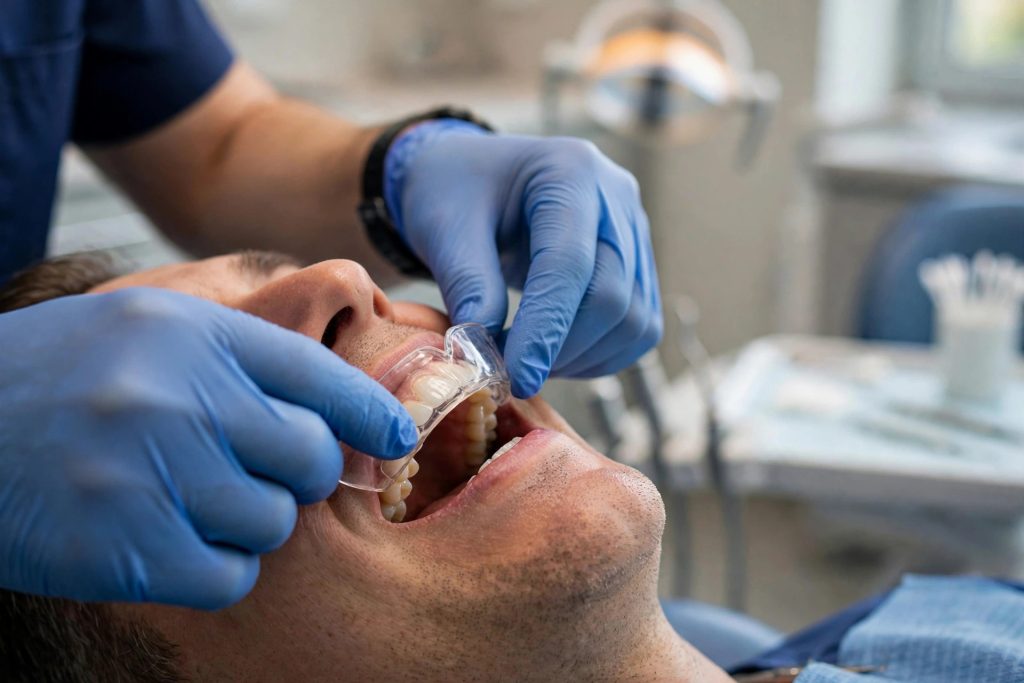
In-office teeth whitening for sensitive teeth allows the dentist to control the gel concentration, protect the gums, monitor sensitivity during the session, and apply desensitizing agents before or after treatment. That control is especially useful for patients who have had sensitivity in the past, or who want a faster result before an event. A dentist can also choose a lower concentration for the first session and adjust from there, rather than starting with the strongest option.
At-home whitening with custom trays
For at-home teeth whitening for sensitive teeth, custom-fitted trays, made from impressions of your teeth, help keep the gel in contact with the teeth and away from the gums. That fit reduces gum irritation and allows a lower-concentration gel to be used for a controlled period each day. Over-the-counter strips can work for mild sensitivity if they are specifically formulated for sensitive teeth, with a lower peroxide concentration and added potassium nitrate. Follow the directions exactly, and do not extend wear time to try to speed results.
For a broader discussion of the advantages and disadvantages of whitening in general, see our earlier article, Brighter Smiles or Hidden Dangers: 10 Pros and Cons of Teeth Whitening
What to Avoid If Your Teeth Are Sensitive
- High-concentration over-the-counter kits. Products with peroxide well above 20% are designed for professional use, with in-office protection. For teeth whitening for sensitive teeth, they are a poor choice — they are likely to cause more sensitivity at home.
- Whitening strips without potassium nitrate. If the label does not list a desensitizing agent, it may not be the best choice for sensitive teeth.
- Charcoal and other abrasive products. Dentists recommend against charcoal whitening products because abrasive charcoal can wear down enamel instead of bleaching stains.
- Purple color-correcting toothpastes as a whitening treatment. These deposit a violet pigment that optically cancels yellow tones. They do not remove stains, and the effect is temporary.
- Overuse. Whitening more often, for longer, or at higher concentrations than directed can damage enamel or gum tissue. The ADA is direct about that risk.
A Gentler Whitening Plan
A practical, dentist-guided plan for teeth whitening for sensitive teeth often looks like this:
- Start with an examination. Check for cavities, cracked fillings, gum recession, and enamel wear before whitening.
- Use a desensitizing toothpaste for two weeks before whitening. Choose one with potassium nitrate and fluoride, and brush twice daily.
- Choose a lower-peroxide formula for teeth whitening for sensitive teeth. A 6–10% hydrogen peroxide product, or a dentist-selected in-office concentration, is often the right starting point.
- Shorten sessions if sensitivity appears. Take a break for a day or two, use desensitizing toothpaste, and resume when comfortable. Do not push through severe pain.
- Avoid very hot, cold, and acidic foods and drinks during treatment. These can trigger sensitivity from exposed tubules.
- Maintain results with good hygiene. Brush twice daily, floss daily, and schedule regular cleanings. Touch-up treatments may be needed periodically, as whitening results typically last a few months to a year.
When to Call the Office
Contact our office promptly if you experience any of the following after teeth whitening for sensitive teeth: Severe pain, or pain that is worsening; Sensitivity that lasts beyond a few days after treatment ends; Sensitivity that does not improve with desensitizing toothpaste; Gum irritation, swelling, or sores that do not settle; A cracked tooth, loose filling, or new pain in a single tooth. These symptoms may indicate a problem that needs an examination, not simply a stronger or weaker whitening product.
What to Expect at a Whitening Visit in Newburgh
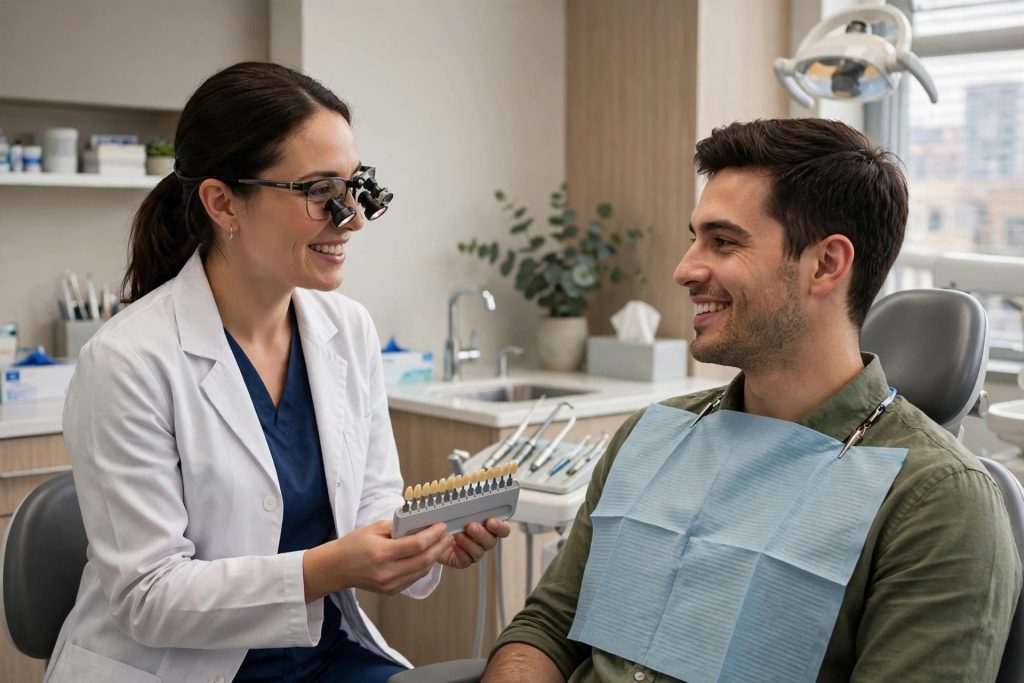
If you come to our Newburgh, NY office for teeth whitening for sensitive teeth, your visit starts with a conversation and a careful look at your teeth and gums. We check for cavities, cracked fillings, receding gums, and worn enamel — the hard outer layer of your teeth — because any of these can make your teeth more sensitive during whitening. We also ask about sensitivity you have already noticed, for example with cold drinks or sweet foods, so we can choose a gentler starting point for you.
Your gums are protected before the whitening gel is applied, and the gel’s strength and timing are chosen for your teeth, not a one-size-fits-all setting. During the visit, tell us right away if you feel a sharp twinge, so we can pause or adjust. Afterward, we may apply a desensitizing product with potassium nitrate or fluoride to help calm your teeth. Most sensitivity fades within 24 to 48 hours. If it does not, or if it gets worse, call us at (845) 562-1108. Whether you live in Newburgh or elsewhere in the Hudson Valley, the goal of teeth whitening for sensitive teeth is the same: a brighter smile that feels comfortable, not a visit you have to dread.
Frequently Asked Questions
Q: Is teeth whitening safe for sensitive teeth? A: Teeth whitening for sensitive teeth is generally considered safe when performed by a qualified dentist or using an approved over-the-counter product as directed. For sensitive teeth, a lower peroxide concentration, desensitizing agents, and professional guidance reduce the risk of discomfort.
Q: How long does sensitivity last after whitening? A: After teeth whitening for sensitive teeth, most sensitivity is temporary and clears within 24 to 48 hours after treatment ends. With strip or tray programs, it often resolves by the fourth day after treatment.
Q: Should I whiten at home or in the office if I have sensitive teeth? A: For teeth whitening for sensitive teeth, in-office whitening gives the dentist the most control over concentration, gum protection, and desensitizing treatment. Custom trays at home are a good middle ground. Over-the-counter products can work for mild sensitivity if they are formulated for sensitive teeth and used exactly as directed.
Q: Does a stronger whitening gel always work better? A: No — for teeth whitening for sensitive teeth, stronger is often worse. A 2026 trial found that a 35% gel whitened more than a 6% gel, but also caused sensitivity far more often and more intensely. A 2026 review of 24 systematic reviews found that moderate concentrations often achieve comparable results to higher concentrations, with less sensitivity.
Q: How should I prepare for teeth whitening for sensitive teeth? A: Start by using a desensitizing toothpaste with potassium nitrate and fluoride for about two weeks before whitening, so the calming effect has time to build — it starts around day 7 and is strongest around day 14. Book an examination first, so we can check for cavities, cracked fillings, gum recession, or worn enamel before you whiten. And plan to avoid very hot, cold, and acidic foods and drinks during treatment, since they can trigger sensitivity.
Q: Can I use whitening strips if I have sensitive teeth? A: You can, if the strips are made for sensitive teeth — look for a lower peroxide concentration and potassium nitrate on the label. Avoid strips without a desensitizing ingredient, and follow the directions exactly: do not leave them on longer than directed to try to speed up your results. If strips still cause discomfort, custom trays from your dentist or a gentler in-office option may suit you better.
Conclusion
Sensitive teeth do not automatically rule out a brighter smile. The evidence points to a gentler, more personalized approach: a lower peroxide concentration, potassium nitrate and fluoride for desensitizing support, a proper examination first, and a dentist who can adjust the plan if sensitivity appears.
If you have been avoiding whitening because of sensitivity, or if a previous whitening attempt left your teeth uncomfortable, a consultation can help determine the safest option for your teeth. To discuss teeth whitening for sensitive teeth, or to schedule an examination and cleaning, call Dr. Michael Koumas, DDS PC, at (845) 562-1108. Our office is at 4 Hudson Valley Professional Plaza #1, Newburgh, NY 12550, and we are open Monday through Friday, 9:00 a.m. to 5:30 p.m. We would be glad to help you find a whitening plan that fits your smile and your comfort.
Sources
- Efficacy and Tooth Sensitivity of Low- Versus High-Concentration Hydrogen Peroxide for In-Office Bleaching: A Randomized Clinical Trial. Journal of Esthetic and Restorative Dentistry, 2026; 38(4): 905–914. https://pmc.ncbi.nlm.nih.gov/articles/PMC13069188/
- Best Teeth Whitening for Sensitive Teeth (2026). Rose Dental Nashua. https://rosedentalnashua.com/best-teeth-whitening-options-for-sensitive-teeth/
- The 11 Best Teeth Whitening Products for Sensitive Teeth of 2026, Tested and Reviewed. Health. https://www.health.com/beauty/best-whitening-products-sensitive-teeth
- Teeth Whitening in Belmont, CA: What 2026 Research Shows. Carlmont Dental Care. https://www.carlmontdentalcare.com/blog/teeth-whitening-belmont-ca
- The best whitening strips for sensitive teeth, according to dentists. CNN Underscored. https://www.cnn.com/cnn-underscored/health-fitness/best-whitening-strips-sensitive-teeth?cid=external-feeds_iluminar_meta
- Does Teeth Whitening Hurt? What Sensitivity Feels Like. Avalon Dental. https://avalondentalny.com/does-teeth-whitening-hurt/
- Brighter Smiles or Hidden Dangers: 10 Pros and Cons of Teeth Whitening. Dr. Michael Koumas, DDS PC. https://www.drkoumas.com/the-pros-and-cons-of-teeth-whitening/